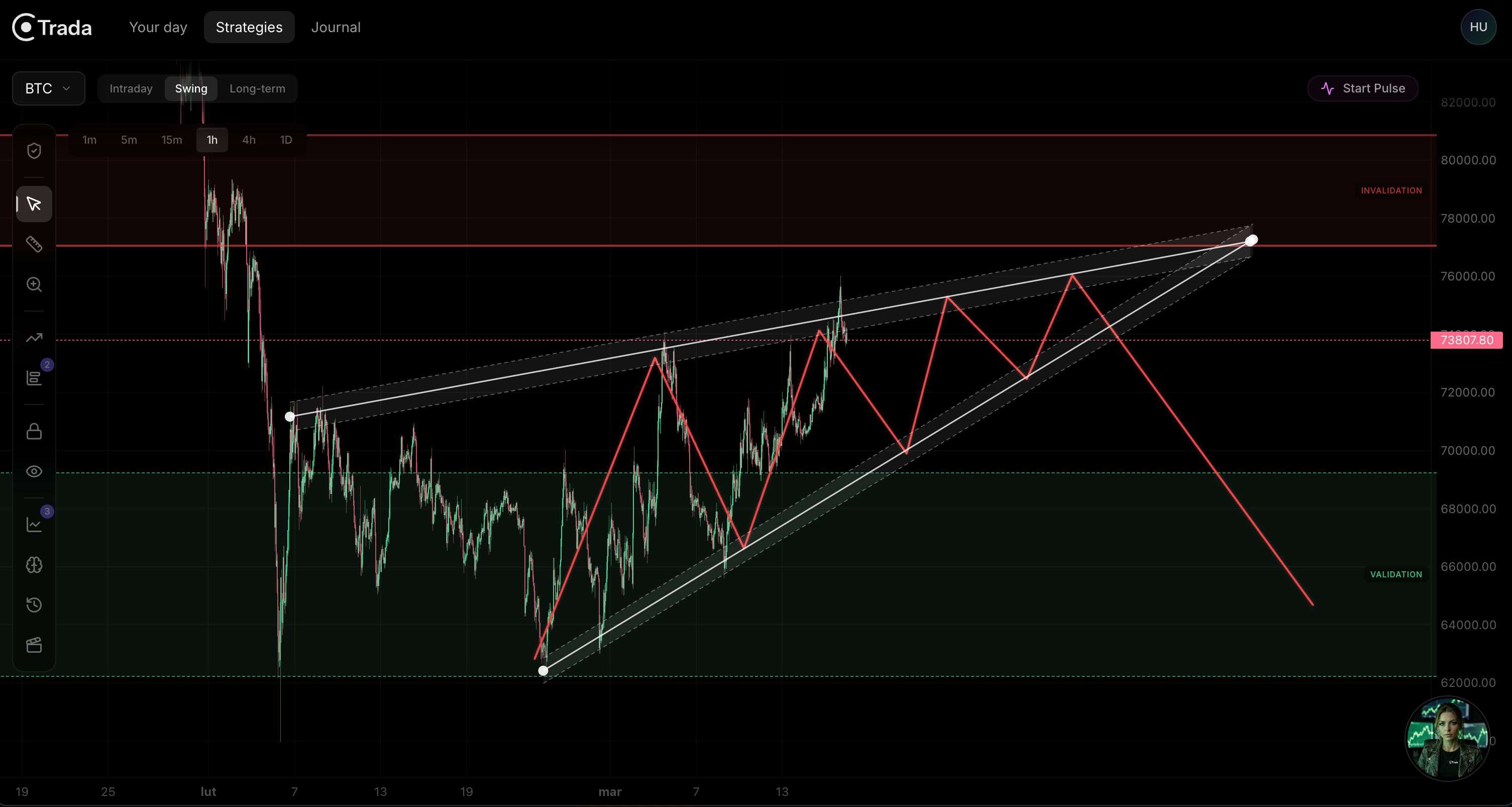
Strategy
Your thesis, expressed on a chart.
A strategy in Trada isn't a signal or a prediction. It's where price should go if you're right, and where it should never go if you're wrong. Draw it once. The system takes it from there. Conditions change? Adjust your zones anytime and let the system adapt with you.
Three horizons per instrument.
Most traders think in one timeframe and get blindsided by the other two. Trada lets you run an intraday scalp, a swing position, and a long-term macro thesis on the same instrument, all monitored in parallel, each with its own zones, patterns, and alerts. Your 5-minute setup never conflicts with your weekly view because they were never meant to be the same trade.
Your strategy has a pulse.
You set the zones. The market moves. The system tells you where you stand: valid, at risk, invalidated, or target reached. No need to stare at the chart waiting for a candle close. Market Pulse watches your levels against live prices and only speaks up when the status actually changes. You stay in the loop without being glued to the screen.
Read more about Market PulseTrend lines
Support and resistance, but alive.
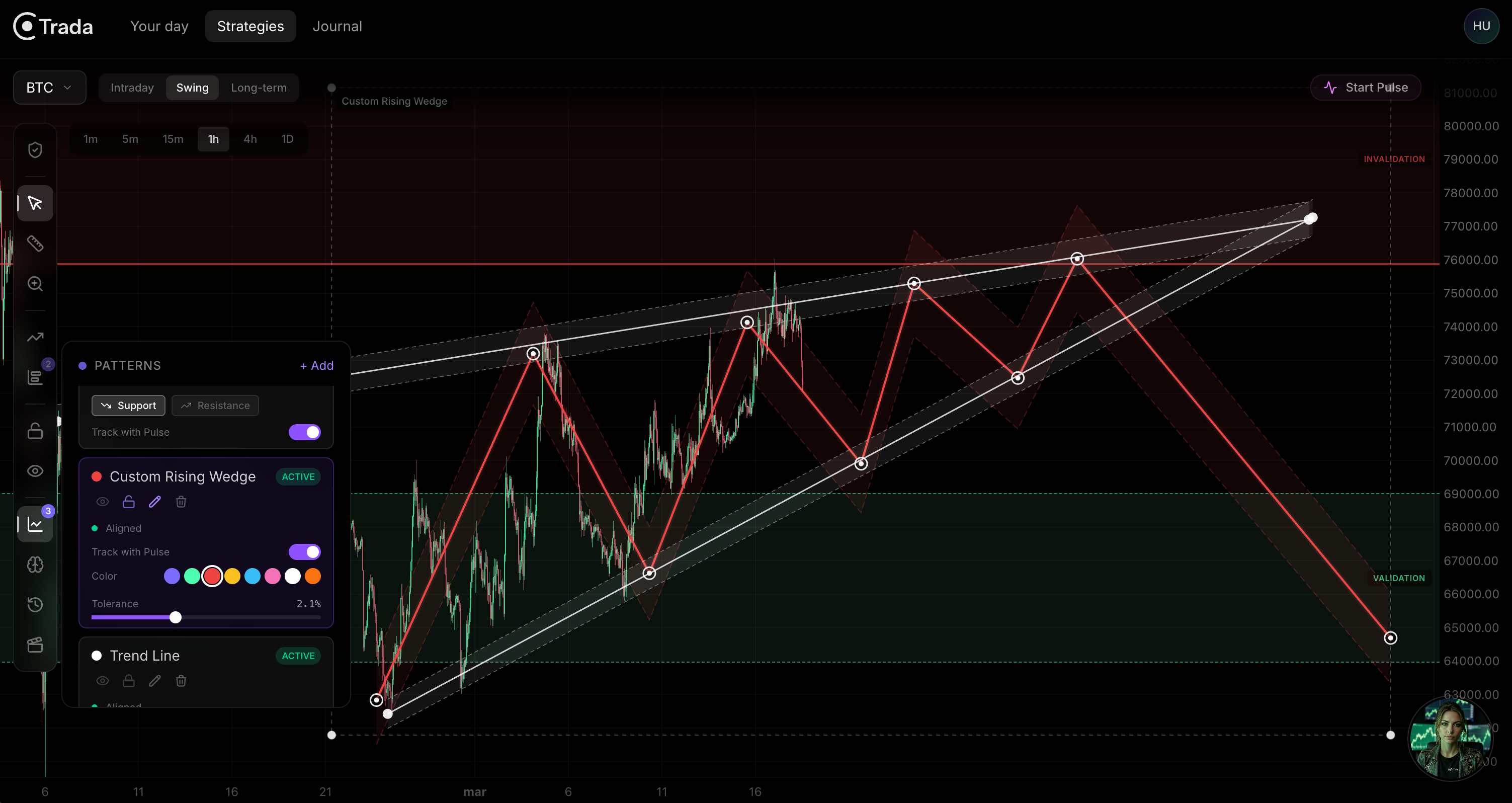
Every trader draws lines on a chart. The difference is what happens after. In Trada, a trend line isn't decoration. Click two points, assign it as support or resistance, and the system starts watching. It tracks five distance states in real time: clear, near, touching, testing, and broken. You know exactly how price is interacting with your level before it's too late to react.
Not just a line on a chart.
Most platforms let you draw a line and forget about it. Trada generates a tolerance band around every trend line automatically, so you're not reacting to a single pixel. Combined with Market Pulse, you get alerted the moment price starts challenging your key levels. No more checking the chart every five minutes to see if your support is holding.
Zones
Four zones. One clear thesis.
Every strategy comes down to four price ranges. Validation is where you expect price to go if your read is correct. Invalidation is where your thesis breaks and you know you're wrong. Target is where you'd consider the move complete. Watch is for secondary levels worth monitoring but not critical to the trade. Two clicks per zone, and the system handles the rest.
Patterns
Annotate the structure you see.
You see a head and shoulders forming, or a rising wedge tightening into resistance. Instead of just remembering it, you draw it. Trada turns that drawing into a monitored object with tolerance bands. The system tracks whether price is aligned with the pattern, stressed against it, or has broken through entirely. Choose from 15 classic templates or draw freeform. Either way, you'll know the moment the structure stops holding.
Market Memory
What happened last time the market looked like this?
You're looking at a chart and the shape feels familiar. Select 30 to 256 candles and the system searches thousands of historical patterns across markets to find moments that looked the same. It normalizes the curve, scores each match on eight components, and shows you what happened next. Did it break out? Consolidate? Fake out and reverse? These aren't predictions. They're real outcomes from real markets that rhymed with what you're seeing right now.
Replay
Step through history. See your edge.
The best way to build conviction in a setup is to see it play out before you risk anything. Replay lets you scrub through past candles bar by bar, with your zones and trend lines drawn on top. Hide the future, watch the structure develop, and ask yourself honestly whether you would have taken the trade. It's backtesting without the spreadsheet.
Record
Capture the session. Share the thinking.
Anyone can post a chart after the move and claim they called it. Recording lets you prove it. Hit record before the session, draw your zones and patterns as you see them, and everything gets timestamped and saved. When the trade plays out, you have a verifiable, replayable document of your entire thought process. Share it with your audience, review it yourself, or just let it build your track record over time.
You've seen the tools
Your next session
starts with a plan.
Draw your thesis. Set the zones. Let the system tell you when you're right and when you're wrong. Everything else is noise.